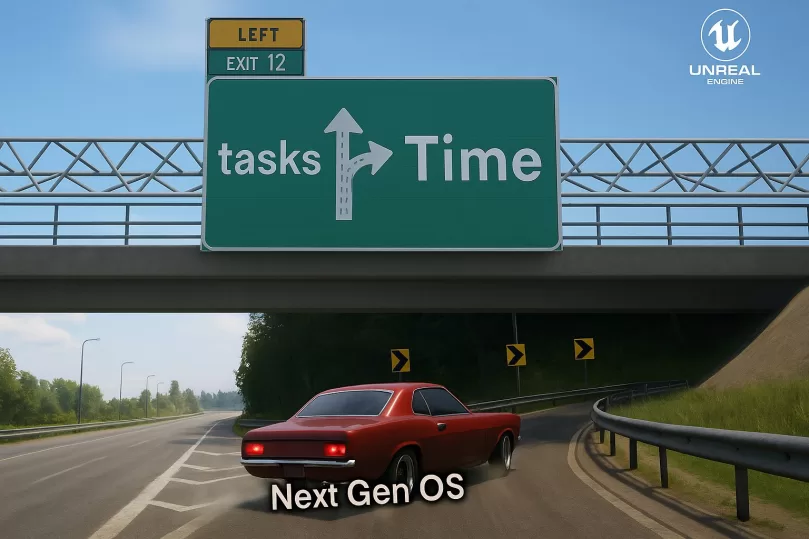
Thesis: Today’s phones are optimized to maximize app time, not human outcomes. The next breakout platform will invert that. It will organize your life across past, present, and future—with an AI that acts on your behalf across time—replacing “apps” with intent-driven tasks, memory, and planning. It starts as a companion app; it grows into a screen-agnostic operating system.
Why we need a new model
History rewards “good-enough” solutions that win early; it rarely revisits ideas that only shine after the 100th iteration. We’re living through one such reversal in compute architectures: ARM-first systems are now the default for phones and are eating the PC and server world because they deliver radically better performance per watt; Apple’s M-series transition made the shift concrete and visible even to consumers. AnandTech Forums
Mobile OSs themselves also reveal a fork in evolutionary paths. Early smartphones fused telephony with a handful of PIM utilities; the iPhone (2007) reframed the category around a multitouch, desktop-class internet device, and Android 1.0 (2008) generalized that into a flexible, third-party ecosystem with background sync, notifications, and the Market. We’ve been polishing that same app grid ever since. Apple+2Wikipedia+2
Meanwhile, AI is changing the contract between users and software. OpenAI’s apps inside ChatGPT (and SDK) make it deterministic to pick an algorithm for a task inside a conversation, shifting UX from “find the right app” to “state intent and let the assistant pick the right tool.” OpenAI
On the hardware side, screenless, wearable first devices aren’t sci-fi any more. Meta’s Ray-Ban glasses ship multimodal “look and ask,” live translation, and hands-free capture today, while the AI-wearable space is iterating—with painful lessons like Humane’s charge-case recall and company shutdown. And credible reporting says OpenAI × Jony Ive are pursuing a screenless, ambient device. The center of gravity is moving from a rectangle of glass to always-with-you sensors + an AI layer. TechCrunch+4About Facebook+4About Facebook+4
Put together, the incumbent “app-home-screen” mental model is the fossil of a world where software had to be launched, not asked.
First principles: phones vs. computers
Computers began as compute devices; their form factor, filesystems, and metaphors (files, folders, programs) descend from batch jobs and GUIs. Phones began as telecom endpoints; their UX (contacts, dialer, messages, camera) grew from communication and capture. Both converged… but their defaults leak through: PCs still assume projects; phones still assume streams and feeds.
That origin explains why phones ship with default apps (dialer, messages, camera, calendar): they’re not bloat; they’re the telecom bones showing through. To a teen raised on super-apps and search-in-everything, these icons feel arbitrary—but they exist because the OS is still app-centric.
The result in 2025: a device that could be your co-pilot is financially incented to be your billboard. You can “buy your freedom” (subscriptions, ad-free tiers), but you’re still swimming upstream of the home-screen/app paradigm.
The new paradigm: time, not apps
The core object model
- Past (swipe left): a searchable, computable timeline of you. People you met, transactions, photos, notes, voice, locations, health metrics, the weather that day, the news context—everything stitched into one memory graph.
- Present (home): two modes
- Geographic: navigate the physical world (capture, meet, learn, ask, record).
- Geodesic: navigate the digital world (public posts, private messages, group spaces, world events) via an AI that routes to the right model or API.
- Future (swipe right): plans, bookings, goals, drafts—where predictions and commitments live.
No apps—just actions. Edit a photo from 2018? The edit creates a branch in the timeline. Re-frame an idea you wrote last month? The PKM layer tracks lineage and alternatives. Think “Git for life,” but invisible.
The onboarding contract
A 15-minute conversation establishes your capabilities, needs, desires, and red lines. The system proposes a weekly reflection cadence keyed to mood, context, and goals. It learns how you want to decide, not just what to do.
Why now (updated priors)
- Ambient hardware is here. Smart glasses and other wearables prove that cameras + mics + compute at the edge are viable and useful. Meta’s glasses already support “what am I looking at?”, hands-free capture, and broader rollouts of Meta AI on-device. About Facebook+1
- Deterministic agent routing exists. ChatGPT’s apps (and SDK) let you call the right algorithm in-flow, with UI elements embedded in the conversation. That’s the substrate for “no apps, just intents.” OpenAI
- From 2D images to 3D understanding. Single-image novel-view/3D tech has leapt forward (e.g., Zero-1-to-3; Stability’s SV3D). A blurry, wide shot can be reconstructed into consistent multi-view representations—enough to power “memory from any angle” and context-aware AR aids. arXiv+1
- Network & edge are maturing. Wi-Fi 7 certification (deterministic latency, multi-link) plus modern 5G/edge patterns make “local-first when possible, cloud-assist when useful” realistic. Artificial Intelligence Act
- Societal guardrails are crystallizing. The EU AI Act’s transparency duties for AI-generated content and open provenance efforts like C2PA make a safer default stack feasible for consumer agents that generate or alter media. Electrek+1
- The app grid is losing gravity. If OpenAI + Jony Ive ship a screenless ambient device, the primary surface becomes conversation + context, not icons—accelerating a shift that’s already visible in the glasses market. TechCrunch
A theoretical OS: Temporal
Data model
- Timeline graph: every object (people, places, media, ideas, transactions) is a node with typed edges (met, bought, captured, read, edited, tagged).
- Branching & provenance: edits produce branches; merges are explicit; everything is diff-able.
- Local-first sync: encrypt-by-default, CRDT-style conflict resolution so the device works offline, syncs when it can, and your device is the source of truth. (Ink & Switch’s “Local-first software” is a useful north star.) Wikipedia
Surfaces
- Present: a single canvas with two tabs—Here (geographic) and Now (geodesic). Capture, ask, act.
- Past: zoomable timeline; “time scrubbing” reveals the state of your graph at any date; “Re-see” uses multi-view reconstruction to relive moments.
- Future: planboard blending timelines (deadlines) with goal trees (outcomes). Agents propose schedules; you approve.
Agents, not apps
- Intent → policy → toolchain. You express intent (“file my reimbursements from last month”). The policy layer checks permissions, jurisdictional rules, and risk. The toolchain layer composes the right AI + APIs deterministically (e.g., a specific OCR + a finance connector + a calendar writer).
- Composable skills: skills are small, typed, testable; they advertise inputs/outputs; they can run on-device or call out to providers.
Privacy & governance
- User-owned keys with social recovery; content credentials attached to generated media; policy manifests that explain what ran, why, and what data moved.
- No ads, period. Business model = hardware margin + compute/network subscription + paid domains (e.g., professional bundles). If we allow a “market,” it’s a skills market, not an ads market.
Practical v1 (startup path)
- Ship as an app (iOS/Android) with Present as the hero surface.
- Capture (photo, voice, screen, link), Ask (unified search + actions), Act (one-tap skills you approve).
- Background indexers for Past (photos, messages, calendar, locations, docs).
- Future as goals + scheduling + booking integrations.
- Deterministic skills via today’s agent stacks.
- Use ChatGPT apps where they exist; wrap others behind your own skills.
- Every skill declares data sharing and logs receipts (who/what/when). OpenAI
- Local-first store with end-to-end encryption; sync to user’s personal cloud of choice; adopt C2PA for any media you transform. Microchip
- Glasses-first edge cases. Build to Ray-Ban/Meta’s feature set for hands-free capture + “what am I seeing?” so the UX already works sans phone screen. About Facebook
- Frictionless onboarding. The 15-minute interview seeds goals, preferences, constraints. The OS proposes a weekly reflection cadence; the user can snooze but the model degrades gracefully.
- Guardrails from day one.
- Policy checks for sensitive requests (e.g., sexual imagery synthesis) defer to law + platform rules; default deny with clear rationale and safe alternatives.
- Per-region policy packs (e.g., EU transparency). Electrek
What we’ll test (and how we’ll know we’re right)
- Task completion rate vs. app-hunting: do users finish more of what they intend when intent → policy → toolchain is one flow?
- Reflection adherence: do weekly check-ins correlate with better plan execution?
- Timeline recall: can users find and re-use past information faster than Photos/Drive/Notes silos?
- On-device vs. cloud mix: measure latency, cost, and acceptance of privacy trade-offs.
- Glasses cohort: among users with Ray-Ban Meta glasses, do hands-free captures and “look & ask” drive more Present→Future actions? About Facebook
Early risks & countermeasures
- Screenless hype vs. reality. Humane’s recall and exit show hardware is hard; our bet is software that works on today’s phones and gracefully degrades on wearables. U.S. Consumer Product Safety Commission
- Agent safety & legality. Embed a transparent policy layer and log every action; adopt content credentials; default to least-privilege scopes. Microchip
- Vendor volatility. The agent/app ecosystem will churn. Our abstraction is skills with deterministic contracts; we can swap providers behind the interface.
- Economics. Compute isn’t free. Our model is clear: user pays for hardware + network + compute (with visible meters and hard caps), not attention.
Appendix: What came before (and why we’re different)
- 1990s–2000s smartphones & OSs: telephony + PIM.
- 2007 iPhone reframed UX around multitouch + desktop-class internet.
- 2008 Android 1.0 added Market, notifications, background sync, and deep Google service integration. We’ve been iterating that app grid ever since. Apple+1
Temporal discards the grid. It treats time as the primary navigation and intent as the primary API.
The ask
The goal is to help define the path to build a Temporal v1 as a capture-ask-act app that already feels like an OS: past as a living memory graph, present as an action canvas, future as commitments we’ll help you keep. We’ll earn the right to become the firmware of your life—whether your screen is in your pocket, on your face, or left at home.
Signals to watch: momentum on OpenAI’s app ecosystem, continued Ray-Ban/Meta adoption, Wi-Fi 7 coverage, and regulatory clarity on content provenance. If those trend up, the window for a time-native OS is open—right now. Microchip+3OpenAI+3About Facebook+3
This post has been written in collaboration with GPT5. This idea of temporal OS has been in a draft stage since the last 2 years. Perhaps since the time ChatGPT came out. I believe the exponential curve of the human potential is about to begin. We are still early to a life where we will use AI as a tool to live our life beyond all imaginations.
This is a humble attempt to nudge the path of the universe in that order. I have not yet verified every single thing about it because of my own personal constraints, but with time I will make greater amends to this project. I hope this idea space expands and takes a life of its own.